Tuesday, June 14, 2022

Red wagon


Originally published May or June 2009 in The Alliance Review.

As my wife and I were walking Sunday morning, we passed a young mother pulling her son in a wagon. Suddenly, he jumped out and raced through what was evidently his yard. “I’ll see you ’round back,” he shouted over his shoulder. Then he was gone.

It is as apt a metaphor for raising kids as I can think of. One moment you’re pulling the wagon, keeping one eye peeled for what’s ahead and the other on the precious cargo behind; the next, you’re staring down at the handle and the remnants of the dependence, wondering what happened, stunned at how quickly the change occurred.

The night before, my wife and I and a few family members and friends had been sitting around a picnic table in the dying light of a beautiful summer’s day, watching as our daughter opened high school graduation cards and gifts. I realized that a major part of our lives as parents was coming to an end. We’d navigated the stormy seas of adolescence: the first love and heartbreak, the academic and athletic successes and failures, the mood swings that took us up and down like yoyos. We’d survived the driver’s license and the dances, the sprained ankles and pulled ligaments, the auditions and ruminations and recriminations (whoever decided it was important for kids to know at age 18 how they will spend the rest of their lives was crazy) that go along with shepherding another life until he or she can start making intelligent decisions without you.

All those times when she and her friends would turn the front porch into a tent city with help from blankets and bed sheets, or we would hand out Popsicles or hot chocolate at the breakfast bar, or play backyard badminton until the grass was wet with dew and it was too dark to see the birdie – those times were gone, proof as always that the days and weeks go slow, but the months and years go fast.

And it occurred to me then that somewhere in the last year, our role had shifted from “sage on the stage” to “guide on the side,” that while she might still come to us for advice and financial help, our days of pointing her in one direction and saying march – and with a headstrong young lady, I could count those days on one hand and have a few fingers left over, anyway – were up.

I wouldn’t have it any other way. I know parents who want to wind back the clock and keep their children forever young, dependent, and innocent. If I were like Peabody and his boy Sherman and had access to a Wayback Machine, I’d want to relive an hour or two every now and again, but I wouldn’t want to stay there.

For one thing, there are too many cool things coming up to spend too much time looking back. I don’t know what shape those things will take, whether they will be the traditional college graduation, wedding, and grandchildren, or if they’ll be more off the beaten track. Likely, there will be a few heartbreaks and unexpected detours (expected detours hardly qualify, do they?), because we forget that the Chinese expression “May you live in interesting times,” is really a curse. Nobody has a guarantee on anything other than this moment, right now, today, anyway, but I’m cautiously optimistic, because it doesn’t pay to be anything else.

“You know,” my mom said to me that Saturday night, “it wasn’t all that long ago that I was planning your graduation party, and now here I am again.”

Parenthood is like that, I guess. I talk to some people who are a little farther along the road and they tell me to wait until my daughter turns 21, or 30, or 50. And I know I won’t have long to wait, because I just blinked and went from 18 to 41, myself.

So my heart was full last Sunday when I saw the little guy jump from the wagon and make his break. I wondered if it would be the last time his mother would ever pull him in a wagon, and maybe she didn’t even realize it.

If I were the advice-giving kind, I would tell her to hop into the wagon herself and hold on tight. It’s the bumpiest, most wonderful ride in the world, and she’ll need all four wheels just to keep up.


Follow Chris Schillig on Facebook and Twitter, and e-mail him at cschillig@the-review.com.
Thursday, June 9, 2022

By my butt she knew me

This column was originally published in October, 2010. Looking it over today, I realize it's somewhat politically incorrect, so Let the Reader Beware and all. 

I was involved in a strange situation a few weeks ago. There’s no delicate way to say this, so I’ll just lay it on the line: Somebody identified me by my butt.

I was jogging down the street, minding my own business – a euphemism for panting so profusely that I sounded like a caller to one of those 1-900 lines where customers talk to Puerto Rican honeys who are really 800-pound sumo wrestlers with effeminate voices – when a cyclist passed me from behind and commented, “I like your columns. I can relate.”

At first, I wasn’t sure if she was relating to my panting or my writing, but I eventually settled on the latter. It’s always nice to hear from a fan, so I wheezed something in response, maybe a thank you that sounded vaguely like “please call an ambulance” as she rolled off.

It was only later that I wondered how she knew who I was. To be honest, these days I don’t look much like the disembodied head that’s floating somewhere to the right of these words. That photo is more than a few years old, and the hair on top has gone the way of the mastodon and the saber-toothed tiger.

I wasn’t wearing anything that openly identified me, and I had never laid eyes on the cyclist before. Seeing as how she identified me from behind, all that’s left is my gluteus maximus. (Oddly, the spell check on Microsoft Word doesn’t like “maximus” and suggests a) “maximum us,” as in, “I don’t want to be alone anymore, baby, let’s have a relationship and make it about maximum us” – or b) “maximums,” as in “I’ve used all my credit cards to the maximums, dude.” Weird.

Anyway, by my butt she knew me.

This is worrisome for any number of reasons, not the least of which is that I want to be known for my mind and my opinions, not for something as shallow as how nice my rump looks as it bobs up and down inside sweat-soaked gym shorts, just below my middle-aged love handles and right above my spindly, hairy legs.

To make matters worse, more and more people have taken to commenting that they’ve seen me running. Granted, none of them has owned up to identifying me by my rump, but who would? Now that my anonymous cycling fan has planted the seed in my head, it’s sprouting weird butt roots in all my running conversations. In other words, I’m beginning to suspect that my behind is behind many of these public sightings.

I’ve become self-conscious as a result, and have taken to wearing sweatpants and longer hooded sweatshirts in the attempt to cover up what has become my defining feature.

Is this the hell of life as a super model, always known for one’s shapely curves and cute dimples? Oh, the toxicity of our modern, superficial society, when a pale, gangly guy like me is afraid to appear in public in running shorts, exposing his natural endowments to a world set on exploiting him.

How many clandestine pictures have been snapped without my knowledge? How many websites are devoted to exploiting my fanny? If I knew, I’d likely be appalled.

On second thought, why should I feel compelled to bury my assets beneath shapeless clothing? I’m not the one who should be embarrassed, forced to hide his light, such as it is, beneath a bushel basket. It’s everybody else who should be cowed by their unabashed staring, their reduction of my gifts to the lowest common denominator, their objectification of my masculinity, the likes of which the world hasn’t seen since Tiny Tim last tiptoed through the tulips, ukulele in hand.

Maybe my new philosophy of dress should be the same as my advice to those who would seek to exploit my derriere: Butt out.

Of course, that could stop traffic, and I don’t want to be responsible, so “butt in” is probably the safest course of action.


Wednesday, June 8, 2022

In search of the Yeti


This column originally ran on Oct. 24, 2013, but has new relevance with the announcement of Monster Fest in downtown Canton in 2023.

Lots of folks consider the end of the Congressional stalemate the biggest news story of last week, but I know better.

The really important news was the announcement that a British geneticist has matched alleged "Abominable Snowman" DNA to a polar-bear species that lived 40,000 years ago. Bryan Sykes of Oxford University is advancing a theory that modern Yeti sightings in the Himalayas may actually be unknown polar- and brown-bear hybrids.

This is where, if I had something worthwhile to add to Yeti/Bigfoot/Sasquatch lore, I'd say, "I don't know what it was I saw in the mountains that day back in 1987, but it sure as heck wasn't a polar bear."

Except that's never happened. I've never been to the Himalayas. Heck, I've barely been outside. I'm one of the lazy tourists that Edward Abbey wrote about in "Desert Solitaire" who experiences the outdoors from the air-conditioned comfort of a car. Any large, shaggy beasts would have to be visible from the road or the lodge, or they'd escape my notice.


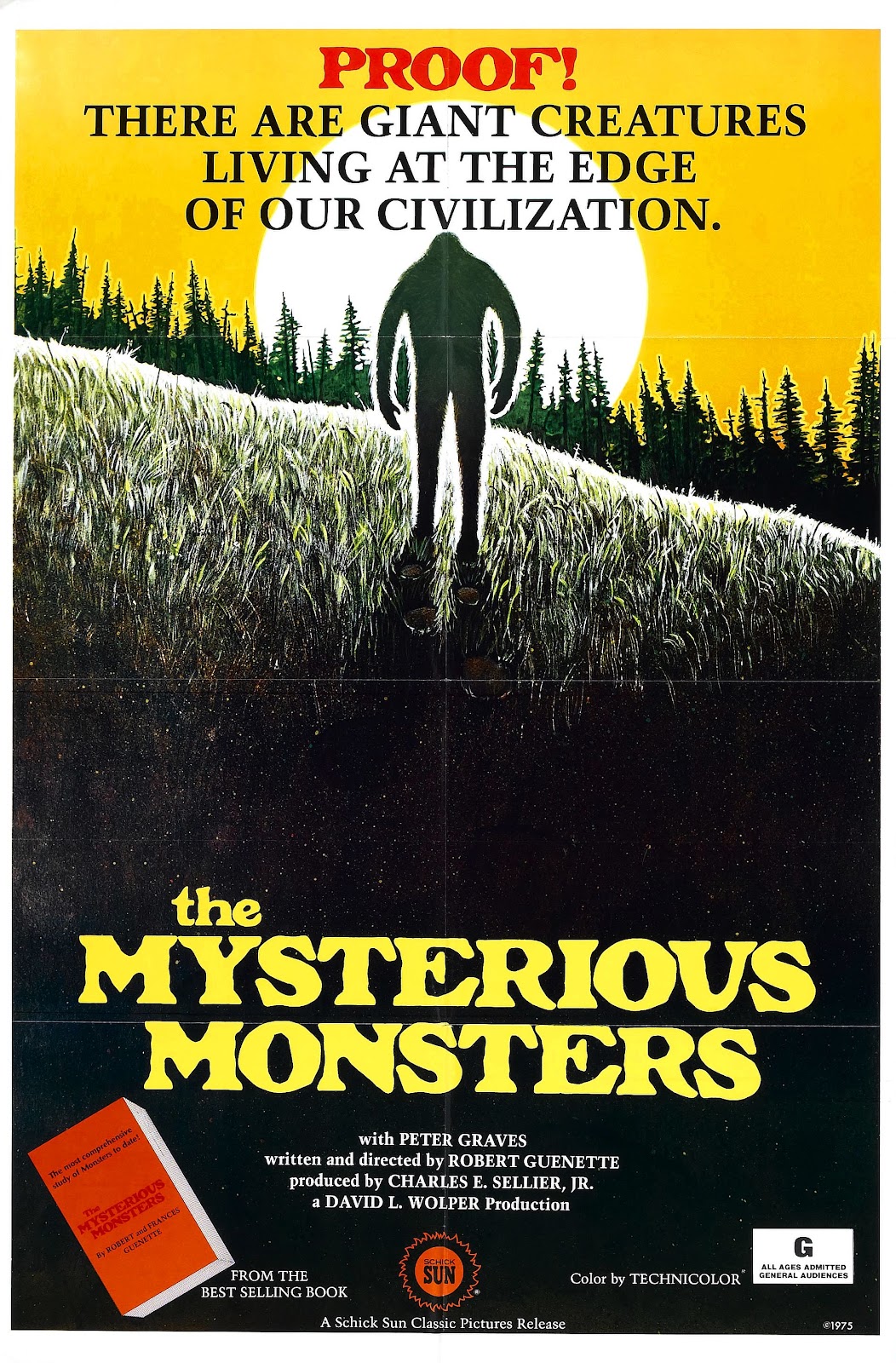
Maybe that's because, as a child, I was traumatized by two books about Bigfoot. I still have "The Mysterious Monsters" by Robert and Frances Guenette, its orangish-yellow cover showing a drawing of a large hominid silhouetted in the light of a full moon. "Proof!" the cover intones. "There are giant creatures living at the edge of our civilization. Astounding new evidence and facts!"


Lost to time, however, is "Sasquatch" by John Napier.

Its cover had been thoroughly gummed by my baby sister, depositing her own DNA into the argument. "STARTLING EVIDENCE OF ANOTHER FORM OF LIFE ON EARTH NOW" it offered, along with the promise of eight pages of "revealing" photographs. (My memory isn't that good, but Google's is.)


The mind of a third-grader being extremely gullible, I accepted Bigfoot, the Loch Ness Monster, and the Yeti as fact, ignoring how most of the cited "experts" were good old boys whose cryptozoological encounters were accompanied by liberal applications of alcohol. The books made it seem like all these creatures were part of a big, extended family, lurking in woods, lakes and snow-capped mountain ranges around the world, getting together once a year — maybe on Christmas or Hanukkah — to swap fruitcakes and stories.

Frighteningly, the swingset in our backyard was located about 50 yards away from an immense woods. In retrospect, it was no more than a few dozen trees that abutted against the neighbors' properties, but at the time, it felt vast. Whenever I went out to play, I kept an eye on that woods, lest some hairy creature lumber out, searching for little boys for a between-meal snack.

The best offense being a good defense (or something like that), I practiced swinging as high as I could and then jumping off in the direction of the house, figuring those few seconds of air time would provide the advantage I needed to outrun a Bigfoot if he chose to attack.

At night, I lay in bed, my copy of "The Mysterious Monsters" opened to the pertinent section ("Exhibit A: The Long History of Bigfoot in America," pages 51-62), listening for the creatures' distinctive cries, wondering if they were smart enough to stand on one another's shoulders and peek through my bedroom window. Or maybe they were in cahoots with the vampires and werewolves I was convinced lurked out there, too.

Growing older, I relegated Bigfoot and his ilk to the Urban -- or, in this case, Rural -- Myth file, thinking about it only when I went into the woods (seldom) or played on a swingset (also rare).

But I'm still curious about the creatures and will click on any link that promises new evidence, even though it's all the same half-baked, rum-soaked conjectures dressed up for a new year.

Sykes' theory sounds more plausible, however. If it does turn out that something really has been terrorizing Himalayan climbers all these years, that would cool. But if it ends up being just a bear, even one as significant as a previously unknown breed, that would be too bad.

Without a little mystery, all we'd have left in the daily news is Congress, and they're a far less interesting breed of Mysterious Monsters.

chris.schillig@yahoo.com

cschillig at Twitter

Please don't give teachers guns

In the wake of the Uvalde tragedy, an old idea has gained new currency: Arming teachers.

For Americans seduced by the rhetoric that “all it takes to stop a bad guy with a gun is a good guy with a gun,” giving teachers firearms makes sense. Potential shooters would take into consideration that a certain percentage of the faculty and staff are carrying and would think twice before targeting a school.

If an attacker did get inside — and mistakes in Uvalde (a door propped open, a complete breakdown of the police command structure) show how easily it can happen and how much carnage can result — then kids and teachers would not be sitting ducks. The teacher could transition from long division or phonics into law-enforcement mode and take out the intruder, to the cheers of her pupils.

But despite the comforting emotional resonance of such a scenario, giving teachers guns is a bad idea. Here’s why.

First of all, it puts more guns in schools. And if the proliferation of firearms in this country has demonstrated anything, it’s that where there are guns, there is a bigger temptation to use and misuse them. Handgun owners are much more likely to die from suicide by gun (men are eight times more likely, women are 35 times more likely), according to a Stanford research study. Accidental shootings are much more likely to happen in households with guns than in those without them.

It stands to reason, then, that the more staff members with guns, the more chances that somebody will get hurt. At the end of 2021, the Giffords Law Center released an updated report of gun accidents in schools. It included a teacher in California who mistakenly discharged his gun while teaching a class about gun safety; three students were injured, including one with ricocheted bullet fragments in his neck.

Most of the cases, based on a quick perusal, involve teachers, resource officers and visitors accidentally leaving weapons unattended, often in school restrooms. Prosaic, everyday stuff caused by complacency, but potential tragedies in the making.

Secondly, the risks involved would not be shared equally across the school population. Students of color are disciplined more often and more harshly than their European-American peers in many schools. Imagine the fear and anxiety for these black and brown students if they attended campuses where their teachers – 72% of whom, nationally, are white – carry weapons in the classroom. Given concerns about systemic racism, would these students be more likely than their peers to have weapons drawn against them when a discipline situation escalates?

Training is also an issue. Ohio Gov. Mike DeWine supports a bill passed by the Ohio House last year that would lessen training requirements for teachers whose districts allow them to carry in the classroom.

The Ohio Supreme Court ruled in 2021 that Ohio teachers who are allowed to carry must complete the same training as the state’s peace officers. DeWine’s – and the bill’s – intent is to relax that standard to the same training provided to a security guard (along with “local” coursework, whatever that means).*

The accuracy of even highly trained police officers suffers in real-life situations, where they hit their targets anywhere from 30% to 50% of the time. Imagine how much worse that could be for teachers, especially in a high-pressure situation involving a classroom shooter and cowering kids, against somebody who may be a former or current student, somebody with whom they have an educational and emotional investment.

It’s that last part that is – for this full-time classroom teacher at least – one of the biggest reasons not to arm educators. Carrying a gun is inimical to a main tenet of education, which is to model compassion, civility and reasoned debate. I don’t want to carry a gun in school, and I don’t want to worry about teaching alongside somebody who is.

Maybe I’m just resentful to live in a society where, for the benefit of some people’s hobby, the rest of us have to adopt military terms like “hardening” when discussing our public spaces, practice cowering in corners and under desks, and have deep discussions about which books are the best to throw at an intruder.

The solution cannot simply be “more guns.” That’s a non-answer that benefits only gun and ammunition manufacturers and a small minority of Americans willing to sacrifice the rest of us on the altar of their John Wayne fever dreams.

* – Incidentally, in what is surely a nominee for Worst Timing Ever, Ohio in mid-June will become the latest state to allow residents over the age of 21 to carry concealed weapons without a permit.

Reach Chris at chris.schillig@yahoo.com. On Twitter: @cschillig.

A good neighbor should support the neighborhood

Like a good neighbor, State Farm wanted to make everybody in the community feel welcome.

The insurance giant began a program recently to donate three specific books about LGBTQ+ to school libraries, teachers and community centers. The company’s corporate responsibility analyst, Jose Soto, had hoped to “highlight [the company’s] commitment to diversity,” not ignite a firestorm of controversy.

But a conflagration is what ensued after a whistleblower leaked the correspondence, which sought five agents in Florida to distribute the books and referenced a wider effort to recruit agents and volunteers nationwide to do the same.

Not surprisingly, some conservative quarters seized on the opportunity to characterize the initiative, a partnership with the non-profit GenderCool Project, as an attempt to “indoctrinate” 5-year-olds. This, despite many counselors’ opinion that talking to kids about sexuality in an age-appropriate way often begins in the lower-elementary grades. Consumers’ Research, the organization that first shared the whistleblower’s leak, even called the insurance company “a creepy neighbor.”

Because of the backlash, State Farm announced this week that it is no longer supporting the GenderCool initiative.

It is instructive to dig beneath the name-calling and corporate-speak and see just how scandalous these three books are – or aren’t.

The volumes are “A Kids Book About Being Transgender,” “A Kids Book About Being Inclusive,” and “A Kids Book About Being Non-Binary.” Each contains a note: “This book is best read together, grownup and kid.”

The “Kids Book About” series has dozens of titles dealing with topics as diverse as adoption, money, cancer and technology. They appear to be general introductions to issues that many youngsters know little about.

The book about transgender features this two-page exchange: “So one night I wrote a note to my parents telling them who I was and slipped it under their bedroom door. After they read it, they walked out, pulled me into a hug, and told me they believed me and that they loved me.” That’s far from indoctrination; it’s much more about acceptance.

Addressing an issue isn’t the same as endorsing it. And having a book in a library or classroom that deals with being transgender or non-binary isn’t going to compel a child to embrace these identities, any more than the hundreds or thousands of depictions of traditional gender roles and heterosexual relationships in other books, television shows, cartoons and movies aren’t enough to make LGBTQ+ kids “go straight.”

Here’s a brutal statistic: Forty-five percent of LGBTQ youth responding to a national Trevor Project survey seriously pondered suicide in the past year. This is more than twice as high as suicidal ideations among the general population of teens.

However, from the same survey, LGBTQ youth who “felt high social support from their family reported attempting suicide at less than half the rate of those who felt low or moderate social support.” Lower rates of attempted suicides were also reported by LGBTQ youth in schools that affirmed their identities.

What’s the best way to get families and peers to affirm these kids? Understanding. What’s the best way to develop understanding? Education. What’s one of the best ways to educate? Reading.

Ergo, when schools and communities remove books that recognize the mere existence of LGBTQ youth, they are in effect removing one of the most effective ways to help these youth successfully navigate an often tumultuous path and to help others in the community understand them. These decisions make kids believe that they are alone. That something is wrong with them. That they are less than.

Kudos to State Farm for trying to reach out, but shame on the company for backpedaling in the presence of misguided traditionalists who want to restrict information, remove literary lifelines and shove particular demographics back into the closet.

These wrongheaded actions could quite possibly be killing our kids.

Reach Chris at chris.schillig@yahoo.com. On Twitter: @cschillig.

Still introverted after all these years


This column originally ran in early February 2012. The Time magazine article is still available (see link below), but the accompanying quiz no longer works. Not surprisingly, I'm still an introvert, as a recent quasi-panic attack reminded me. 

“The Upside of Being an Introvert” in the Feb. 6 Time magazine was a come-to-Jesus moment for me.

The article by Bryan Walsh begins with the author’s story of hiding in the bathroom of the American Embassy in Tokyo, where he works up courage to later mingle with the powerful elite at a holiday party. It proceeds to explain how introverted people, often labelled (sometimes erroneously) as “shy,” are a product of both nature and nurture. In other words, their disposition toward large crowds is determined by genetics and environment.

I nodded my head in recognition so often while reading Walsh’s piece that I reminded myself of one of those dunking-bird toys that perpetually dips beak into water before swinging up again, propelled by a liquid counterweight in its bottom. When Walsh describes the exhaustion that introverted people often feel at social gatherings, I bobbed my head in agreement. When he talks about the introvert’s preference for working alone, I nodded again. When he noted that “introvert” need not be a synonym for “shy,” I was practically salaaming before the magazine and shouting “Amen,” despite the religious mixed metaphor, because it so perfectly dovetailed with my personality.

I answered yes to 19 out of 20 questions on an accompanying quiz, agreeing emphatically with statements such as, “I prefer not to show my work or discuss it with others until it is finished,” “I dislike conflict” and “If I had to choose, I’d prefer a weekend with absolutely nothing to do to one with too many things scheduled.” Along the introvert/extrovert continuum, I’m siding with the quiet folks.

The only statement that drew a “No” is this: “People describe me as soft-spoken or mellow.” And that, in perpetuity, has been the crux of my inner personality debate.

People who know me from my schooldays would likely remember me as a clown, if they remember me at all. I fancied myself the wiseacre in the back of the room, king of the quick quip or double-entendre, the guy who knew just how far to push without angering an instructor. “Shy” and “introverted” probably aren’t the first adjectives that come to mind, for instance, when people recall my humiliating performance as Quasimodo during a report for a book I didn’t read. (I moaned like an animal for two minutes, pretending I was the hunchback being whipped by the evil Claude Frollo.)

Yet outside of classroom situations that were my comfort zone, I was -- and am -- painfully introverted. I never attended a school dance. I never tried out for a sports team. I have never directly asked anybody out on a date. (My wife asked me.) My sales career ended when I found it too painful to continue risking daily rejection by strangers, when I literally could not cold-call anymore.

To this day, I feel anxiety when entering wedding receptions, calling hours, or speaking in a crowd. Rarely do I make a telephone call where I wouldn’t rather hang up before it is answered. If I can email or text instead, I do.

Oddly enough, however, I make my living as a teacher, standing in front of a room of strangers every August and hoping that my knocking knees and shaking hands aren’t too obvious. Each day, I attempt to win over students with corny jokes, a toothy grin and a carnival barker’s persona. If I’m overly tired, these tools fail me, and all I’m left with is the Real Me, who’d much rather sit in the back of the room and pretend to listen while hiding a Mad Magazine inside my textbook.

By the time Friday rolls around, all this extroversion leaves me with just enough energy to crawl back into my cave, pull shut the front door and hide inside a book or a movie with some take-out food before I pull on my extrovert’s mask again on Monday.

Even this split-personality, which for most of my adult life I have considered patently bizarre, is explained by Walsh’s article. Brian Little, a Harvard lecturer and researcher, calls it the Free Trait Theory, which Walsh defines as “the idea that while we have certain fixed bits of personality, we can act out of character in the service of core personal goals.”

For me, that personal goal is making people laugh. I was good at it in the back of the room, I fancy myself as competent at it here in print, and I like to think I’ve developed a penchant for it in front of people, as well.

Because I firmly believe that when people are laughing, with me or at me, they are more open to new opportunities and ideas. That they learn better. And teaching, while I would prefer to do it in the privacy of my own home and from behind the safe anonymity of a computer screen, is a noble-enough calling to force me outside my comfort zone.

It’s what keeps me from living inside my shell 24/7 like a hermit crab and sends me out into the world each morning, mingling when I’d rather be retreating and speaking when I’d rather be listening.

At least now I know why.

chris.schillig@yahoo.com or @cschillig on Twitter

Tuesday, June 7, 2022

Reading aloud

This is a very old column, probably from fifteen years ago. My wife and I resurrected the reading-together habit during the COVID lockdown and continue it today. 

For the last few years, my wife and I have been reading aloud together.

This may seem an unusual twenty-first-century pastime, but it has an honorable pedigree. Before television sucked away society’s soul, books were a primary form of entertainment. What better way to experience them than around crackling fire (or, today, under an electric blanket), bringing a writer’s words to life via voice?

Our modern reading odyssey began with an author apt for Halloween: Stephen King. In the foreword to Part 1 of his 1996 serial novel, “The Green Mile,” King tells how he, his brother, and his mother would take turns reading stories aloud from The Saturday Evening Post.

“It was a rare chance to enjoy a written work as we enjoyed the movies we went to and the TV programs (Rawhide, Bonanza, Route 66) that we watched together; they were a family event,” he writes. He then urges readers to share “The Green Mile” as a read-aloud with a friend.

My wife and I took him up on that, reading each monthly installment and agonizing over the weeks between. When it was over, we were read-aloud addicts.

In the last ten years, we have plowed through dozens of books. Sometimes, our work schedules and outside commitments conflict, and we do not read together for weeks or even months.

However, when a book is compelling enough, we always make time, reading late into the night or early on weekend mornings (weekday mornings are always too hectic) until we reach the final page.

Most of our selections are novels, including many by King and suspense maestro Richard Matheson. For a while, when Matheson’s works had found renewed interest in Hollywood, we battled to stay ahead of the local cinema with “Stir of Echoes” and “What Dreams May Come.” (Both books are better.)

We read Dan Brown’s “The Da Vinci Code” but stalled on its precursor, “Angels and Demons” (too similar). We loved Mark Haddon’s “The Curious Incident of the Dog in the Night-Time,” told from the point of view of a young man with Asperger’s Disorder, even though the singular way Haddon tells the story – with many pictures and diagrams – made it a challenge to read aloud.

Sometimes, a book fails to catch our attention, at least collectively. We started “Cold Mountain” together, but I finished solo. Holly slogged on to the end of Billie Letts’ “Where the Heart Is” after my interest flagged.

We have tried a few short story collections. Ray Bradbury is a proven winner, especially his early work, like “Small Assassin” and “The Jar,” both recommended for Halloween. Anthologies, by their nature, are more of a mixed bag, and we seldom read one straight through.

In non-fiction, we have read and enjoyed Nathaniel Philbrick’s “In the Heart of the Sea: The Tragedy of the Whaleship Essex,” an excellent account of an incident that may have inspired Herman Melville to write that whale of a novel, “Moby Dick.” We were three chapters into James Frey’s “A Million Little Pieces” when the author was publicly shamed for making large parts of it up, and we lost all interest.

Currently, we are enjoying a novel very appropriate for this spooky season, “Creepers” by David Morrell. It tells the story of a group of urban explorers – people who break into abandoned buildings to chronicle the history left behind – and what happens when they discover more than they bargained for in a singular New Jersey hotel.

Like all of Morrell’s books, the author researches his topic meticulously, dropping specific references to methods and tools of urban exploration to create verisimilitude, so that when the inevitable weirdness begins, readers accept it without hesitation.

And, in an odd case of coincidence or synchronicity, one of the writers to whom Morrell dedicates his book is Matheson, another of our read-aloud regulars, whose “Hell House” bears certain thematic similarities. Morrell was also inspired to become a writer after watching “Route 66,” one of the shows King mentions in the “The Green Mile” foreword that started my wife and me on our read-aloud journey.

Those tempted to hum the Nitty Gritty Dirt Band’s “Will the Circle Be Unbroken” have my permission.

And anybody curious about the read-aloud experience should start with “Creepers” or one of the other titles given thumbs up here. The process is low tech, requires little or no electricity, and beats most anything on TV these days.

A crackling fire is optional but recommended.